
I was on the phone last week with a restoration owner in Dallas. Let’s call him Mike. Mike told me he’d just dropped $8,000 on Google Ads, got 14 calls, and closed exactly two jobs. One of those was a small bathroom fan leak that barely covered the ad spend. Then he asked me, half-joking, “Is SEO dead, or am I just cursed?”
I laughed because I hear that question at least three times a month. And I always give the same short answer: SEO isn’t dead. But what you think SEO is? That’s been dead for years.
If you run a water, fire, or mold restoration company right now, you’re living in a world where a homeowner’s first move during a disaster is to yell at their phone. They don’t want your portfolio, they want your truck in their driveway 20 minutes ago. In 2026, showing up in that moment without spending a fortune on ads is not only possible, it’s the single smartest business move you can make. But you have to play the game the way Google plays it today, not the way you did during the pandemic.
Let me walk you through SEO Guide for Water Damage Restoration Companies and what’s actually working on the ground right now, with zero fluff, and then I’ll answer the questions I get from owners every single day.
The “Zero-Click” Emergency Is Already Here
A pipe freezes and bursts at 2 a.m. in a Chicago suburb. The homeowner, standing in ankle-deep water, grabs their phone and mumbles, “emergency water damage repair near me now.”
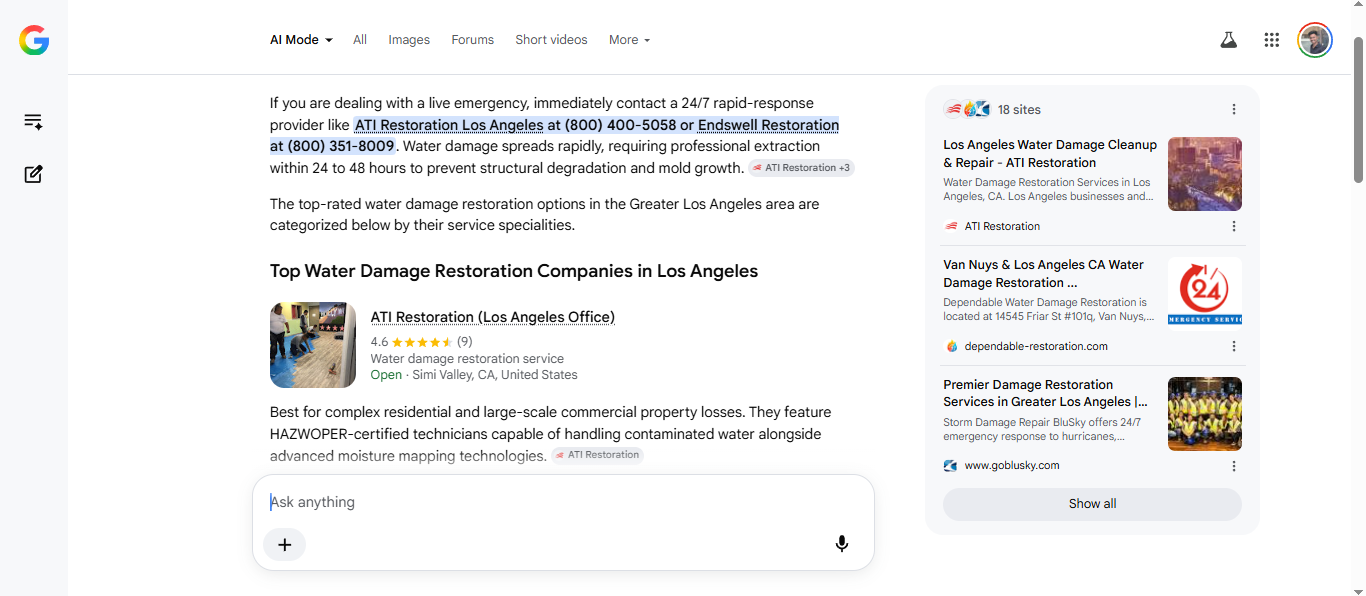
Google’s AI Overview (the big answer box at the top) immediately shows them a list of three businesses, their star ratings, and a button to call without them ever scrolling down, let alone clicking a website. That’s a zero-click search. Your job is to be the business that Google’s AI pulls the trigger on.
If your company’s name, reviews, and local reputation aren’t woven into the very fabric of Google’s understanding of your service area, you become invisible in the moments that matter most. And that understanding is built entirely by modern SEO: the kind that prioritizes trust signals, hyper-local relevance, and genuine helpfulness over keyword stuffing and spammy directories.
The Economy Demands Real Trust, Not Tricks
Restoration isn’t like choosing a restaurant. It’s an emergency, and the person searching is scared. They need someone who will show up, deal with the insurance mess, and not make things worse. In 2026, Google gets that. Its local ranking system for emergency services leans heavily on signals that scream “this business is reliable right now”:
- Response speed: Does your Google Business Profile show you answer messages in minutes, not hours?
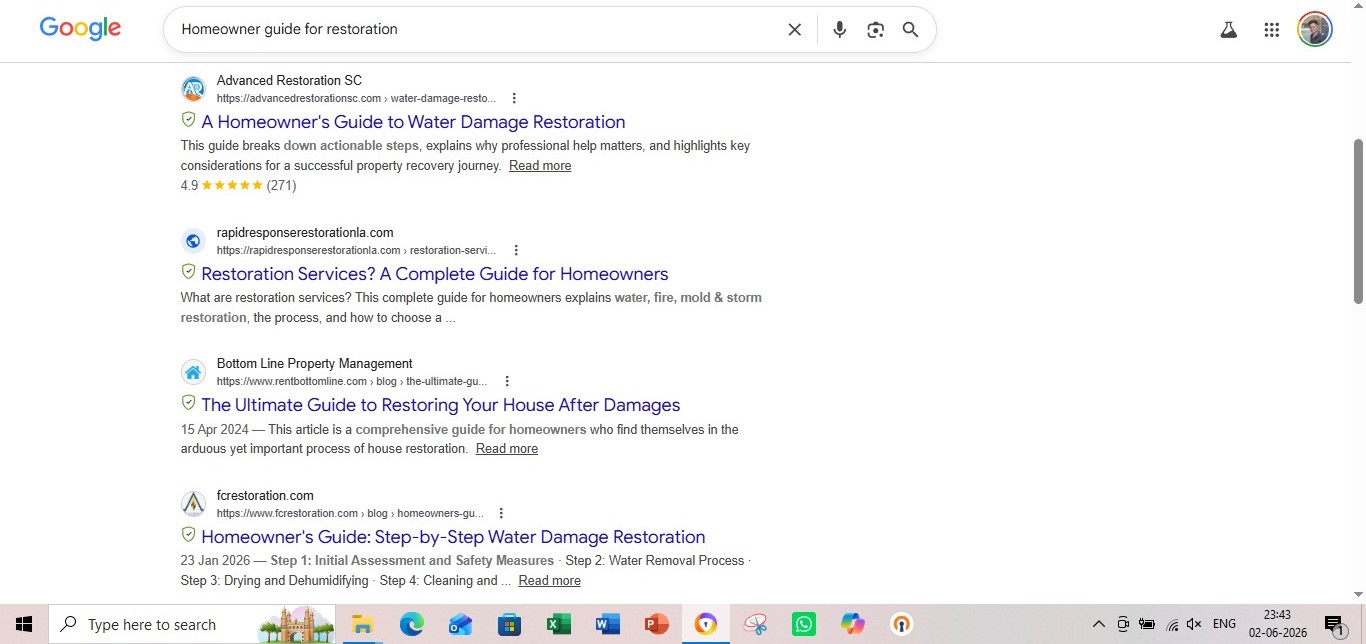
- Review language: Do your 5-star reviews use words like “fast,” “mold remediation,” “smoke smell,” and “helped with the claim” naturally?
- Community footprint: Is your business clearly tied to specific neighborhoods not just a city name through consistent mention on local blogs, news sites, and partner pages?
Think of Organic SEO as the skeleton supporting your Google Business Profile and your Local Service Ads. Without a healthy skeleton, the whole thing collapses no matter how much ad money you pump in. I’ve seen companies with a killer GBP but a garbage website drop out of the 3-pack within a month after Google’s core updates. The two are linked, always. below is an example of How the Google AI Overviews recommend companies.
What’s Actually Moving the Needle Right Now
Over the last 18 months, working with restoration companies across 14 states, here’s what I’ve watched turn browsers into callers.
1. Stop Writing “Fire Damage Restoration City Name” Pages. Tell Survivor Stories.
Back in 2020, you could slap 700 words about fire cleanup on a page, pepper it with “Springfield,” and watch it climb. Today, that same page gets ignored because it doesn’t actually help a person who just watched their kitchen burn.
The winning pages now are real-world guides written by people who’ve been on a job site. I’m talking about content like “My home just had a fire a step by step guide to the first 24 hours for Homeowners.” It walks you through:
- What to touch and what to leave alone.
- How to photograph damage for insurance before the board-up crew arrives.
- Where the gas shut-off is for homes built before 1980 in a specific zip code.
We’ve embedded 40-second videos of our clients’ crews doing board-up or water extraction right into those pages, and Google is starting to surface those video clips inside AI Overviews for “how to” queries. That’s free, trust-building exposure you can’t buy.
2. Build the Whole Recovery Ecosystem, Not Just a Service Page
Google’s machine learning models in 2026 don’t just match keywords they map entities and relationships. If your website only talks about water extraction, you’re a one-dimensional character. The authority comes when you connect the dots across the entire recovery journey:
water damage → mold growth timelines → insurance claim walkthroughs → temporary housing resources → contents pack-out tips.
Create genuinely useful resources, like “How to read your 2026 homeowner’s policy after a water loss (with examples),” and link out to non-competing, reputable local sources a trusted insurance adjuster you know, a contents restoration partner, a public adjuster who’s not a crook. When you become the hub, Google treats you as the local authority on disasters. I’ve seen this lift organic traffic by 40-60% in six months for companies that commit to it.
3. Your Reviews Need to Tell a Story, Not Just Rate You
A five-star rating used to be enough. Now, it’s the table stakes. The 2026 ranking differentiator is what I call review narrative depth. Google’s AI reads the text, and it understands the difference between “Great job guys” and:
“The mold remediation crew arrived in under an hour, explained every step, set up containment and air scrubbers immediately, and helped me fill out my insurance paperwork before they left. I can’t believe how stress-free they made a terrible week.”
We coach our clients to ask every happy customer a simple follow-up question in their review request text or email: “How was our response time? Did our walkthrough help with your claim?” That tiny nudge triples the chance of a review that feeds Google exactly what it’s looking for. And yes, velocity matters — getting three solid reviews a week tells Google you’re active, responsive, and relevant right now.
4. Go Microscopically Local, or Go Home
You’ll never out-SEO a national franchise for “water damage restoration [Big City].” They have 500 locations and a link budget that would make your head spin. But you can dominate the long-tail hyper-local queries that actually convert into high-ticket jobs. Think:
- “3rd floor condo water damage restoration Arrowhead Ranch”
- “fire smoke cleanup historic district Savannah lath and plaster”
- “sewage backup cleanup finished basement Naperville 1920s home”
These searches might only get 10-30 searches a month, but the person typing them already knows exactly what they need, and they’re ready to hire. We’ve seen these low-volume keywords convert at over 50% on phone calls. Create dedicated, in-depth pages or blog posts for these micro-areas, and make sure the content references real landmarks, building types, and local challenges. That’s where the franchises can’t compete.
The ROI Math That Shuts Up the Skeptics
Let’s keep it real with the numbers I’m seeing in 2026. In competitive metro markets, a click for “water damage restoration near me” on Google Ads is running anywhere from $90 to $160 per click. A single qualified call might cost $500-$800 in ad spend. After you pay for the clicks, you still have to close the job, and a lot of those calls are tire-kickers or people price-shopping.
A mature organic SEO strategy, once it gains traction, flips that equation on its head. The clicks are free. The leads are often warmer because they found you through a helpful article or your sterling reputation, not a paid ad they may not fully trust. I have a client in Phoenix who now gets 40-50 qualified emergency calls a month from organic search alone.
They close about 20% of those into jobs averaging $5,500. That’s $55,000 in revenue a month, over half a million a year, with a customer acquisition cost that’s a rounding error. And that doesn’t include the commercial contract calls that come from searches like “industrial fire cleanup Phoenix.”
SEO isn’t a cost. It’s an asset you own. It doesn’t stop working when you pause a budget, and it doesn’t get more expensive every time a competitor enters the auction. That’s why when owners ask me if it’s “worth it,” I tell them the truth: If you plan to sell your business one day, a diversified, non-paid lead pipeline is one of the biggest multipliers of your valuation.
So, Does SEO Still Work? Let Me Put It This Way.
SEO for restoration in 2026 isn’t about tricking a search engine. It’s about proving to a machine and more importantly, to the human on the other side that you are the most helpful, nearby, and competent person to call on the worst day of their year.
If your website looks like a 2019 brochure with a phone number slapped on it, you’re not just losing rankings. You’re actively handing money to the competitor who decided to answer the question before the homeowner finished typing it.
if you are Restoration Company you should must follow this SEO Guide for Water Damage Restoration Companies and if you are planning to start SEO soon but not sure how to start the SEO, how to fix errors on website and all don’t worry we are here to help, Book a call by clicking the button below and get your 1 Month of Free SEO*
Now, let’s get to the questions I hear over and over.
Frequently Asked Questions
You’ll usually see movement in local rankings and long-tail terms within 3–4 months. Competitive “water damage [city]” terms can take 8–12 months. Anyone promising #1 in 30 days is lying.
Yes, but not on broad city terms. Win by going hyper-local specific neighborhoods, real job photos, and genuine community presence. Authenticity beats corporate budgets in 2026.
Yes, but quality over quantity. One link from a local news story or chamber of commerce is worth a thousand spammy directory listings.
Critical. It’s not just the star rating Google reads the actual words. Aim for 3–5 detailed reviews per week that mention specific services like “fast water extraction” or “helped with my claim.
You can, but that’s rented land. Organic SEO feeds your ad trust score and keeps leads coming even when you pause ad spend. It’s both, with SEO as the backbone.
Still using a 2019-style brochure site. If your pages don’t answer real emergency questions (“What do I do first after a pipe bursts?”), you’re handing customers to the competitor who does.
Yes “Hey Google, find an emergency water damage company near me” is how many people search now. Write conversationally and keep your Google Business Profile perfectly accurate. That’s most of the battle.